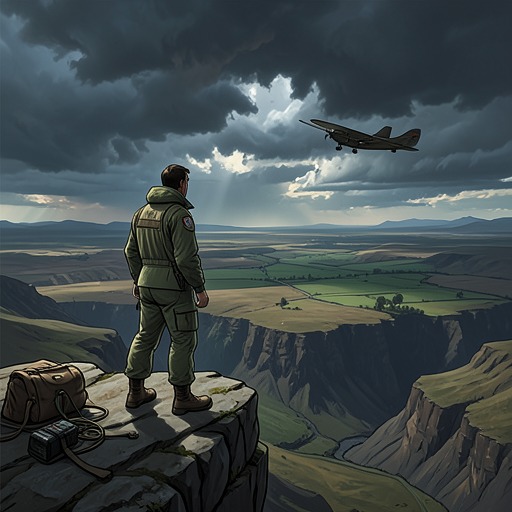
The 1956 Pilot Operating Handbook
The Dog StarsThe 1956 Pilot Operating Handbook is the original flight manual for Hig’s Cessna, an old but indispensable source of performance data. In the canyon, its tables help Hig judge whether the aircraft can take off with Pops and Cima aboard and shape a plan to bring Pops back later. The manual offers hard numbers, but those numbers were gathered under conditions far removed from a rough strip in a sage field; its importance lies as much in that gap as in its calculations.
Physical Form and Provenance
Hig retrieves the manual from the vinyl pocket behind his seat. It is the original 1956 edition, less than an eighth of an inch thick and eighty-eight pages long, with an illustration of the aircraft on its cover. Its slimness does not make it casual reading: Hig handles it carefully, treating the worn book as a valuable artifact. Even its physical condition matters to the scene, since the cover has come detached while the data inside remain usable.
The manual belongs to an earlier world of formal aviation testing. As Hig studies its performance tables, he imagines the people who produced them: technicians recording results and plotting curves, and veteran Second World War pilots testing the aircraft at the Cessna center in Wichita. He pictures those pilots carrying their military experience into postwar life and finding, in the familiar movement of a propeller plane, a kind of release from ordinary constraints. This history is Hig’s reflection on the manual, not evidence that its pages can answer the changed conditions around him.
What the Tables Measure
The section titled Take-Off Data gives distances for different elevations, temperatures, and wind conditions. At an airfield elevation of 7,500 feet, an air temperature of 32 degrees Fahrenheit, and no headwind, the listed distance for an aircraft at empty weight to clear a fifty-foot obstacle is 950 feet. Hig traces the table by elevation and temperature to find the relevant figure. The result is specific, but it applies to a particular set of assumptions, not automatically to every aircraft load or runway.
To turn the manual’s table into a practical estimate, Hig brings out a separate certified weight-and-balance sheet for his individual aircraft and works through the loading on clean paper. His proposed figures include Pops at 180 pounds, Cima at 120, provisions at 20 pounds, and five gallons of water at 40 pounds, as well as fuel, firearms, grenades, and oil. The handbook supplies the performance framework; the aircraft-specific sheet and Hig’s calculations supply other pieces of the decision. The distinction is important: neither the table alone nor the weight figures alone settle whether the loaded plane can clear the trees.
Applying Old Data to the Canyon
The figures were compiled with test pilots taking off from smooth tarmac under ideal conditions. A soft field reduces performance, and the uneven track through the sage presents a more serious uncertainty. Hig considers filling ruts and smoothing the surface, but he cannot make the canyon strip equivalent to the conditions behind the handbook’s curves. The book therefore helps him reason about risk without promising a safe outcome.
Fuel and payload become part of that practical reasoning. Hig siphons twelve extra gallons out of the aircraft because the group does not need them to reach Grand Junction and removing them saves seventy-two pounds. He then reconsiders, adds back what he estimates to be about two gallons, leaves one full can hidden in the sage, and empties the other. These adjustments are not numbers supplied by the manual; they are decisions made while Hig uses its takeoff data alongside his own weight calculations and the realities of the departure site.
The calculations lead him to a painful initial conclusion: the best chance of clearing the trees appears to require leaving Pops behind. Rather than announce that conclusion as a settled verdict, Hig takes the handbook, the weight-and-balance sheet, his worksheet, and pencil to the lunch table. He has left the weights blank on the page he shows the others, allowing Pops to follow the problem. When Pops recognizes the purpose of the exercise, the manual has become more than a reference book: it is part of a conversation in which a technical constraint must be faced openly.
A Plan Beyond the First Takeoff
The final plan depends on what happens after the aircraft leaves the canyon. Hig explains that fourteen gallons are needed in part because the plane must land and take off again. He proposes taking Cima first and collecting Pops from a straight stretch of highway near a bridge turnoff, which would provide enough runway. Pops’s response shows that the calculations have altered the discussion: he understands that the original plan would leave him behind, but the fuel requirement and proposed pickup make a later reunion possible within Hig’s plan.
The handbook does not itself prescribe this sequence, guarantee the highway landing, or remove the hazards of the rough field. Instead, its tables help Hig distinguish an immediate departure problem from the larger question of how to evacuate the group. Technical knowledge here is useful precisely when joined to judgment: the manual gives a measured baseline, while the conditions demand adjustments and a plan beyond the first takeoff.
Narrative Significance
The manual carries the authority of a carefully measured past into a landscape where its original assumptions no longer hold. Its curves and distances remain legible, yet the smooth tarmac of the tests contrasts with the rutted sage track, just as the fixed precision of the tables contrasts with the uncertain work of getting people out of the canyon. The object neither fails nor offers a complete solution. It makes the problem calculable enough to discuss while leaving Hig and Pops responsible for what the figures cannot settle.
Its detached cover and fragile pages also mark the manual as a surviving piece of the old technical world, handled with care because no comparable resource is readily available. In the evacuation discussion, that artifact helps turn private calculation into shared understanding. The decision is still shaped by terrain, weight, fuel, and risk, but the book gives those pressures a form that Pops can examine and answer.